
If your dentist has detected that your gums have receded substantially, you may be referred to a periodontist for a gum graft. Gum recession occurs when the tissue surrounding each tooth pulls away, exposing more of the tooth or the tooth root. This exposure can cause significant damage to the supporting bone, in addition to causing tooth sensitivity. Gum recession happens over time, so you may not notice when it’s happening. If left untreated, gum recession will result in tooth loss. Gum grafting repairs this damage before it gets even worse.
Types of Gum Grafts
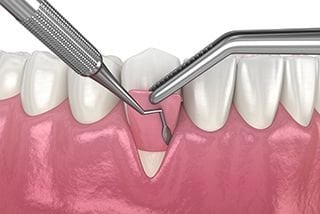 Depending on your mouth’s unique needs, your periodontist will choose one of the following types of gum grafts:
- Connective Tissue: The most common type of graft to treat root exposure is a connective tissue graft. In the roof of your mouth, a flap of skin is cut and pulled back. Tissue underneath this flap, known as subepithelial connective tissue, is then removed and stitched to surround the exposed tooth root. Once this is finished, the flap in the roof of your mouth is also stitched down.
- Free Gingival: A free gingival graft is similar to the connective-tissue graft because it also uses tissue from the roof of the mouth. However, instead of creating a flap, tissue is directly removed from the roof of the mouth. This tissue is then attached to the area of the gums that is being treated. This graft is most often used for people who have thin gums.
- Pedicle: For a pedicle graft, tissue is taken from the gums near the tooth needing repair. The flap, known as a pedicle, is partially cut away so that one edge stays attached. The gum is stretched over to cover the exposed root and is then sewn in place. This graft can only be performed on people who have enough gum tissue near the affected tooth.
- Tissue Bank: There are some patients and periodontists who prefer to use graft material from a tissue bank instead of the patient’s own mouth. Tissue-stimulating proteins are added to encourage the body’s natural ability to grow bone and tissue.